
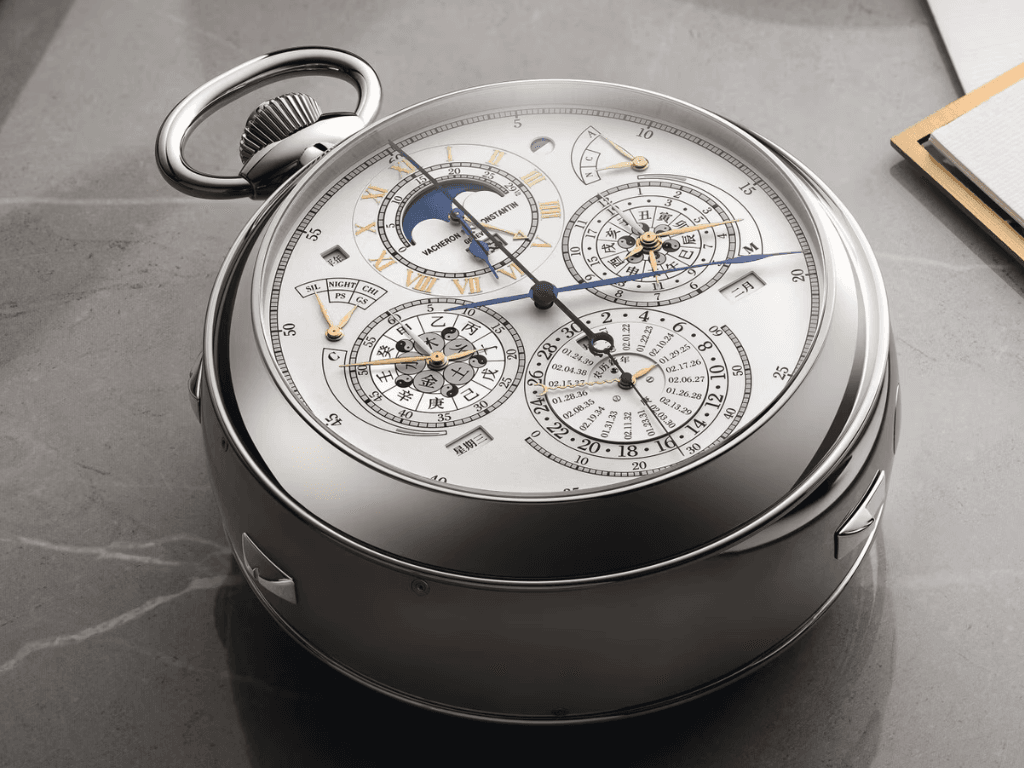
Beyond Hours and Minutes: The Real-World Guide to Watch Complications In horology, the term "complication" sounds like a problem you’d want to avoid. In reality, it describes any mechanical task a wristwatch performs beyond simply displaying hours, minutes, and seconds.
Beyond Hours and Minutes: The Real-World Guide to Watch Complications In horology, the term "complication" sounds like a problem you’d want to avoid. In reality, it describes any mechanical task a wristwatch performs beyond simply displaying hours, minutes, and seconds.
Whether it is a tiny date window nestled at three o'clock or an intricately chime-tuned minute repeater, complications represent the boundary where micro-engineering meets everyday art. If you are exploring mechanical watches, understanding these features helps you appreciate what is actually happening beneath the dial—and decide which mechanisms actually fit your wrist and lifestyle.
- Calendar Complications: Keeping Track of Days and Decades Calendar mechanisms range from straightforward daily conveniences to mechanical marvels that require no manual adjustment for over a century.
Date Window: The most common complication in watchmaking. A rotating disc beneath the dial displays the current date (1–31) through an aperture, usually at the 3, 4:30, or 6 o'clock position. Because standard date wheels assume every month has 31 days, you must advance them by hand at the end of February, April, June, September, and November.
Day-Date: Popularized prominently by Rolex's Day-Date (the "President") in 1956, this adds the spelled-out day of the week to the numerical date.
Triple Calendar (Complete Calendar): Displays the date, day of the week, and month. While informative, it still operates on a standard 31-day cycle and requires manual correction after every month with fewer than 31 days.
Annual Calendar: A major leap in mechanical computing. Developed in the 1990s, an annual calendar automatically differentiates between 30- and 31-day months. It only requires a single manual adjustment per year: on March 1st, after February concludes.
Perpetual Calendar (Quantième Perpétuel): One of horology’s crowning achievements. Using a complex system of levers, star wheels, and mechanical memories, a perpetual calendar accounts for 28-, 30-, and 31-day months, as well as the 29 days of a leap year. As long as the watch remains running, it will not require manual correction until the year 2100 (a non-leap century year under the Gregorian calendar).
- Timing Complications: Measuring Elapsed Time When precision timing is required on demand, stopwatches built directly into movements step forward.
Chronograph A chronograph allows you to measure elapsed intervals without interrupting standard timekeeping. Operated via pushers—typically flanking the winding crown—the central seconds hand begins sweeping on command, while dedicated sub-dials register accrued minutes and hours.
Standard Chronograph: Requires you to stop the timing sequence before pressing a second pusher to reset to zero.
Flyback Chronograph: Originally conceived for aviators who needed instant split-second recalculations, pressing the reset pusher while timing immediately stops, resets, and restarts the chronograph hand in one continuous motion.
Split-Seconds (Rattrapante): Features two superimposed seconds hands. Pressing a third pusher freezes one hand to capture an intermediate split time while the secondary hand keeps tracking total elapsed time. A second tap catches the frozen hand back up to the moving one.
- Travel Complications: Navigating Time Zones As global aviation expanded in the mid-20th century, watchmakers engineered movements capable of tracking time across borders.
Dual Time: Displays two independent hours simultaneously, often using a dedicated 12-hour sub-dial paired with an AM/PM indicator.
GMT (Greenwich Mean Time): Uses an additional 24-hour hand pointing to a graduated 24-hour bezel or rehaut. This lets you track local time on the primary handset while the 24-hour hand indicates home time (or UTC), instantly distinguishing whether it is 2:00 PM or 2:00 AM back home.
Worldtimer: Built with a rotating 24-hour ring and an outer ring listing 24 major global cities representing primary time zones. A quick glance tells you the current hour in London, Tokyo, New York, or Geneva simultaneously.
- Astronomical Complications: The Sky on the Dial Before time was standardized into modern clock grids, human timekeeping was fundamentally astronomical. Modern celestial complications preserve this lineage.
Moonphase: Tracks the lunar cycle through an aperture shaped to reveal the illuminated portion of the moon across its 29.53-day synodic month. Beyond its poetic aesthetic, a traditional 59-tooth moonphase gear accumulates only one day of error roughly every 2.5 to 3 years, while high-precision astronomical moonphases remain accurate for centuries.
Equation of Time: Displays the difference between "true solar time" (determined by the sun's actual position in the sky) and "mean solar time" (standardized 24-hour civil time). Because Earth’s orbit is elliptical and tilted, solar noon varies from standard clock noon by roughly -14 to +16 minutes throughout the year.
- Acoustic Complications: Telling Time by Sound Before electric lighting, chiming watches allowed owners to tell the time in pitch darkness. Today, they represent some of the most labor-intensive finishing in mechanical craft.
Alarm: A mechanical hammer strikes a dedicated gong or membrane inside the case at a preset hour, creating an audible buzz or chime.
Minute Repeater: Activated by a case-side slide or pusher, tiny tempered steel hammers strike tuned circular gongs wrapping around the movement. The watch audibly chimes the time on demand: low notes for the hours, alternating high-low tones for the quarter-hours, and high notes for the remaining individual minutes.
- Power and Regulation: Movement Health and Accuracy Power Reserve Indicator: Acts like a fuel gauge on the dial, measuring the remaining tension stored within the mainspring barrel so you know when the watch needs to be wound or worn.
Tourbillon: Invented by Abraham-Louis Breguet in 1795 to counteract the drag of gravity on a pocket watch's balance wheel. The entire escapement and balance assembly sits inside a rotating cage (typically completing one revolution every 60 seconds). While the positional shifts of a wristwatch on a moving arm diminish its original functional necessity, the tourbillon remains a premier showcase of fine micro-mechanics.
Choosing the Right Complication The value of any complication comes down to how you live with your watch:
For the Daily Driver: A simple date window or a legible GMT hand offers clean legibility with minimal need for constant resetting.
For the Tactile Enthusiast: The mechanical click of a column-wheel chronograph pusher or the fluid sweep of a flyback hand delivers an interactive physical connection to the machinery.
For the Connoisseur: High complications—such as perpetual calendars, split-seconds chronographs, and minute repeaters—turn the dial into a canvas of micro-mechanical problem-solving, celebrating hundreds of individual gears, levers, and springs harmonizing within a 40-millimeter case.